

Common · Knowledge
Quantum phase estimation algorithm
Quantum algorithm to estimate the eigenvalue of a unitary operator
In quantum computing, the quantum phase estimation algorithm is a quantum algorithm to estimate the phase corresponding to an eigenvalue of a given unitary operator. Because the eigenvalues of a unitary operator always have unit modulus, they are characterized by their phase, and therefore the algorithm can be equivalently described as retrieving either the phase or the eigenvalue itself.
From Wikipedia
In quantum computing, the quantum phase estimation algorithm is a quantum algorithm to estimate the phase corresponding to an eigenvalue of a given unitary operator. Because the eigenvalues of a unitary operator always have unit modulus, they are characterized by their phase, and therefore the algorithm can be equivalently described as retrieving either the phase or the eigenvalue itself. The algorithm was initially introduced by Alexei Kitaev in 1995. Phase estimation is frequently used as a subroutine in other quantum algorithms, such as Shor's algorithm, the quantum algorithm for linear systems of equations, and the quantum counting algorithm.
Text: Wikipédia, CC BY-SA 4.0. · Image: Bender2k14 (CC BY-SA 3.0) ·
Related cards
-
 ★★
★★
Savitzky–Golay filter
Algorithm to smoothen data points
-
 ★★★
★★★
Quantum electrodynamics
Abelian gauge theory describing quantum interactions of the electromagnetic field with matter
-
Q★★
Q10 (temperature coefficient)
Equation that connects rate-determining step and temperature
-
 ★★
★★
Hungarian algorithm
Combinatorial optimization algorithm for the assignment problem
-
 ★★★★
★★★★
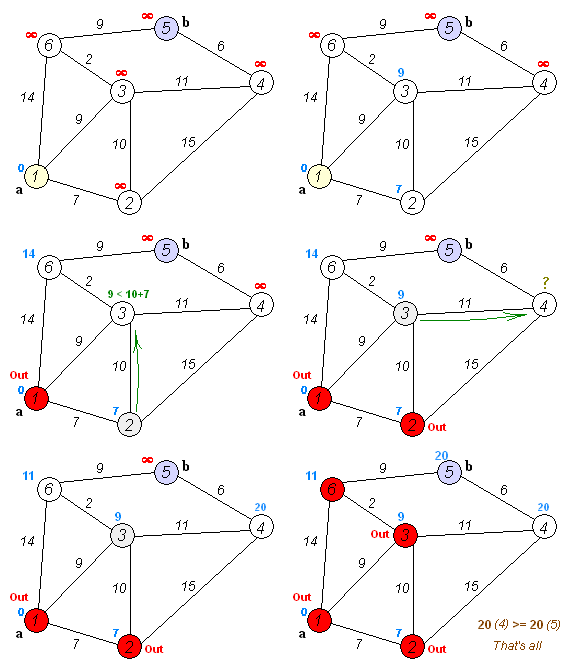
Dijkstra's algorithm
Graph search algorithm
-
D★
Dynamic mode decomposition
Computer algorithm
-
N★
Newey–West estimator
Statistical tool
-
I★
Isospin
Quantum number related to the weak interaction
-
 ★
★
Elitzur–Vaidman bomb tester
Quantum mechanics thought experiment that uses interaction-free measurements to verify that a bomb is functional without having to detonate it
-
D★
Deutsch–Jozsa algorithm
Quantum algorithm
-
 ★★
★★
Aharonov–Bohm effect
Electromagnetic quantum-mechanical effect in regions of zero magnetic and electric field
-
 ★
★
Smith–Waterman algorithm
Algorithm performs local sequence alignment
-
 ★
★
Born approximation
Scattering theory
-
 ★★
★★
Conjugate gradient method
Method to compute systems of linear equations whose matrix is symmetric positive-definite
-
 ★
★
IBM Q System Two
First modular utility-scaled quantum computer system
-
 ★
★
Interval arithmetic
Method for bounding the errors of numerical computations
-
 ★
★
Koopman–von Neumann classical mechanics
Formulation of classical mechanics in terms of Hilbert space
-
P★★
Parseval's identity
Mathematical concept