

Parseval's identity
Mathematical concept
In mathematical analysis, Parseval's identity, named after Marc-Antoine Parseval, is a fundamental result on the summability of the Fourier series of a function. The identity asserts the equality of the energy of a periodic signal (given as the integral of the squared amplitude of the signal) and the energy of its frequency domain representation (given as the sum of squares of the amplitudes).
Nº Q944238 ★★
Uncommon · Knowledge
Parseval's identity
Mathematical concept
In mathematical analysis, Parseval's identity, named after Marc-Antoine Parseval, is a fundamental result on the summability of the Fourier series of a function. The identity asserts the equality of the energy of a periodic signal (given as the integral of the squared amplitude of the signal) and the energy of its frequency domain representation (given as the sum of squares of the amplitudes).
From Wikipedia
In mathematical analysis, Parseval's identity, named after Marc-Antoine Parseval, is a fundamental result on the summability of the Fourier series of a function. The identity asserts the equality of the energy of a periodic signal (given as the integral of the squared amplitude of the signal) and the energy of its frequency domain representation (given as the sum of squares of the amplitudes). Geometrically, it is a generalized Pythagorean theorem for inner-product spaces (which can have an uncountable infinity of basis vectors). The identity asserts that the sum of squares of the Fourier coefficients of a function is equal to the integral of the square of the function, ‖ f ‖ L 2 ( − π , π ) 2 = 1 2 π ∫ − π π | f ( x ) | 2 d x = ∑ n = − ∞ ∞ | f ^ ( n ) | 2 , {\displaystyle \Vert f\Vert _{L^{2}(-\pi ,\pi )}^{2}={\frac {1}{2\pi }}\int _{-\pi }^{\pi }|f(x)|^{2}\,dx=\sum _{n=-\infty }^{\infty }|{\hat {f}}(n)|^{2},} where the Fourier coefficients f ^ ( n ) {\displaystyle {\hat {f}}(n)} of f {\displaystyle f} are given by f ^ ( n ) = 1 2 π ∫ − π π f ( x ) e − i n x d x . {\displaystyle {\hat {f}}(n)={\frac {1}{2\pi }}\int _{-\pi }^{\pi }f(x)e^{-inx}\,dx.} The result holds as stated, provided f {\displaystyle f} is a square-integrable function or, more generally, in Lp space L 2 [ − π , π ] . {\displaystyle L^{2}[-\pi ,\pi ].} A similar result is the Plancherel theorem, which asserts that the integral of the square of the Fourier transform of a function is equal to the integral of the square of the function itself. In one-dimension, for f ∈ L 2 ( R ) , {\displaystyle f\in L^{2}(\mathbb...
Text: Wikipédia, CC BY-SA 4.0. ·
Related cards
-
P
Parseval's theorem
Theorem
Nº Q1443036 ★★
-
J
Jacobi identity
Property of some binary operations, such as the cross product and any ring's commutator
Nº Q1151539 ★
-
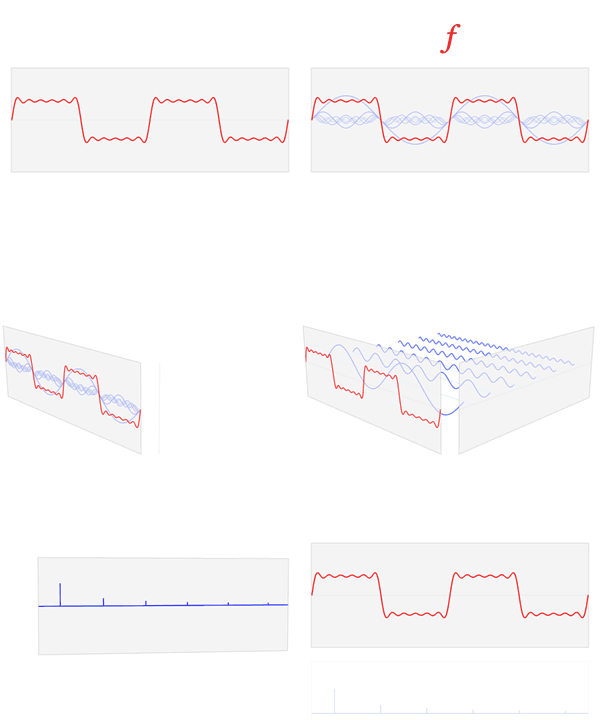
Frequency domain
Signal representation
Nº Q786423 ★
-
P
Poisson summation formula
An equation that relates the Fourier series coefficients of the periodic summation of a function to values of the function's continuous Fourier transform
Nº Q387743 ★
-

Bézout's identity
Formula relating two numbers and their greatest common divisor
Nº Q513028 ★★★
-
L
Lagrange's identity
Mathematical identity in algebra
Nº Q1206853 ★