

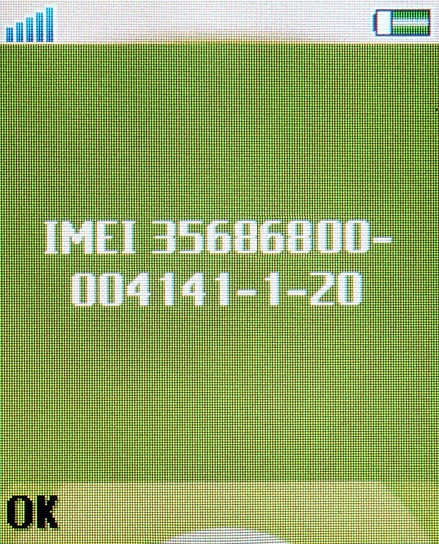
Type Allocation Code
Identifier
The Type Allocation Code (TAC) is the initial eight-digit portion of the 15-digit IMEI and 16-digit IMEISV codes used to uniquely identify wireless devices. The Type Allocation Code identifies a particular model (and often revision) of wireless telephone for use on a GSM, UMTS, LTE, 5G NR, iDEN, Iridium or other IMEI-employing wireless network.
Nº Q4405342 ★
Common · Knowledge
Type Allocation Code
Identifier
The Type Allocation Code (TAC) is the initial eight-digit portion of the 15-digit IMEI and 16-digit IMEISV codes used to uniquely identify wireless devices. The Type Allocation Code identifies a particular model (and often revision) of wireless telephone for use on a GSM, UMTS, LTE, 5G NR, iDEN, Iridium or other IMEI-employing wireless network.
From Wikipedia
The Type Allocation Code (TAC) is the initial eight-digit portion of the 15-digit IMEI and 16-digit IMEISV codes used to uniquely identify wireless devices. The Type Allocation Code identifies a particular model (and often revision) of wireless telephone for use on a GSM, UMTS, LTE, 5G NR, iDEN, Iridium or other IMEI-employing wireless network. The first two digits of the TAC are the Reporting Body Identifier. This indicates the GSMA-approved group that allocated the TAC. Prior to January 1, 2003, the global standard for the IMEI started with a six-digit Type Approval Code followed by a two-digit Final Assembly Code (FAC). The Type Approval Code (also known as TAC) indicated that the particular device was approved by a national GSM approval body and the FAC identified the company that had built and assembled the device (which is not always the same as the brand name stamped on the device). Effective on that date, many GSM member nations and entities (mainly Europe) moved away from requiring that devices be approved by national bodies, and towards a system where device manufacturers self-regulate the device market. As a result, a manufacturer now simply requests an eight-digit Type Allocation Code for a new phone model from the international GSM standards body, instead of submitting a device for approval to a national review body. Both the old and new TAC uniquely identify a model of phone, although some models may have more than one code, depending on revision, manufacturing location, and other factors.
Text: Wikipédia, CC BY-SA 4.0. · Image: Olaf Baumann (CC BY-SA 3.0) ·
Related cards
-
I
ISO/IEC 38500
Standard for corporate governance of information technology
Nº Q3511613 ★
Not listed
-

ISO/IEC 7810
Standard for ID cards
Nº Q1193705 ★★
Not listed
-
C
Compound annual growth rate
CAGR is a term for the geometric progression ratio that provides a constant rate of return
Nº Q1422850 ★★
Not listed
-

4G
Fourth generation of cellular communications standards
Nº Q79697 ★★★
Not listed
-

0-10-0
Locomotive wheel arrangement
Nº Q3517951 ★
Not listed
-

CORDIC
Algorithm for computing trigonometric and hyperbolic functions
Nº Q116076 ★★
Not listed
-
H
Hierarchical administrative subdivision codes
Codes to represent names of country subdivisions, such as states, province, regions
Nº Q3013341 ★
Not listed
-

TEAC Corporation
Company
Nº Q1549408 ★★★
Not listed
-

ATC code C
Section of Anatomical Therapeutic Chemical Classification System relating to drugs affecting the cardiovascular system
Nº Q433932 ★
Not listed
-
A
ANSI/TIA-568
Telecommunication cabling standards
Nº Q1142434 ★★★
Not listed
-
A
ATC code A11
Vitamins is a therapeutic subgroup of the Anatomical Therapeutic Chemical Classification System
Nº Q266008 ★★★
Not listed
-

AT (form factor)
Motherboard form factor
Nº Q298688 ★
Not listed
-
A
Artificial Intelligence Markup Language
XML dialect for creating natural language software agents
Nº Q188545 ★
Not listed
-

Over-the-air update
Secure distribution of software, configuration settings, or encryption keys to electronic devices via an insecure connection
Nº Q2088106 ★★★
Not listed
-

Digital object identifier
ISO standard unique string identifier for a digital object
Nº Q25670 ★★★★
Not listed
-
A
ATC code N
Section of Anatomical Therapeutic Chemical Classification System relating to drugs affecting the nervous system
Nº Q375737 ★
Not listed
-
T
TAK
Lossless audio coding format
Nº Q1153141 ★
Not listed
-
N
Narrowband IoT
Radio technology standard
Nº Q25021569 ★★
Not listed