

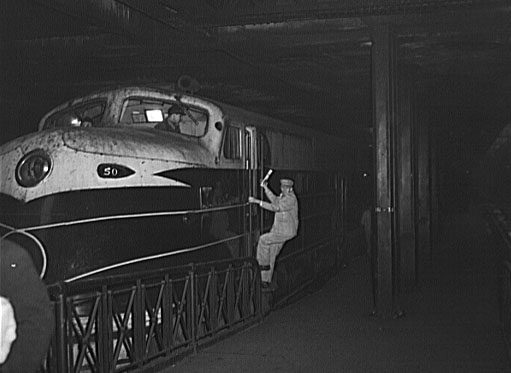
EMD E-unit
Series of American twin-engine passenger diesel locomotive models
EMD E-units were a line of passenger train streamliner diesel locomotives built by the General Motors Electro-Motive Division (EMD) and its predecessor the Electro-Motive Corporation (EMC). Final assembly for all E-units was in La Grange, Illinois.
Nº Q630089 ★
Común · Saberes
EMD E-unit
Series of American twin-engine passenger diesel locomotive models
EMD E-units were a line of passenger train streamliner diesel locomotives built by the General Motors Electro-Motive Division (EMD) and its predecessor the Electro-Motive Corporation (EMC). Final assembly for all E-units was in La Grange, Illinois.
En Wikipedia
Texto en inglés Aún no hay artículo en tu idioma: extracto en inglés.
EMD E-units were a line of passenger train streamliner diesel locomotives built by the General Motors Electro-Motive Division (EMD) and its predecessor the Electro-Motive Corporation (EMC). Final assembly for all E-units was in La Grange, Illinois. Production ran from May 1937, to December, 1963 with 1,294 units produced. The name E-units refers to the model numbers given to each successive type, which all began with E. The E originally stood for eighteen hundred horsepower (1800 hp = 1300 kW), the power of the earliest model, but the letter was kept for later models of higher power. The predecessors of the E-units were the EMC 1800 hp B-B locomotives built in 1935. These had similar power and mechanical layouts to the E-units, but in boxcab bodies on AAR type B two-axle trucks. EMC also introduced the TA model in 1937, selling six to the Rock Island. This had similar carbody styling, but otherwise had more in common with UP M-10001, M-10002, and M-10003 to M-10006, in that it was a 1,200 hp (900 kW), single-engined unit on B-B trucks instead of the E-units' A1A-A1A wheel arrangement. It is not part of the E-unit series. The EMD F-units followed the basic B-B truck design of the TA model, but with a V-16 EMD 567 prime mover generating 1350 hp as introduced in 1939. E-units standardized the two engine configuration for passenger locomotives to maximize power and, while the less-reliable Winton Diesel prime movers were in use, faced a less severe loss of power should one of the engines become disabled. While E-units were used singly for shorter trains, longer trains needed multiple locomotive units; many railroads used triple units. E-units could be purchased with or without cabs; units with a cab are called A units or lead units, while cabless units are...
Texto: Wikipedia en inglés, CC BY-SA 4.0. · Imagen: Jack Delano, part of the Farm Security Administration - Offi... (Public domain) ·
Cartas cercanas
-

EMD E6
Model of 2000 hp American passenger cab diesel locomotive
Nº Q12057133 ★
Sin ofertas
-

EMD E9
Model of 2400 hp American passenger cab locomotive
Nº Q5323405 ★
Sin ofertas
-

EMD FT
Model of 1350 hp American cab locomotive
Nº Q940352 ★
Sin ofertas
-

EMD E8
Modelo de locomotora de cabina de pasajeros estadounidense de 2250 Caballos de fuerza
Nº Q5323404 ★
Sin ofertas
-

EMD F-unit
Series of American cab diesel locomotives
Nº Q630075 ★
Sin ofertas
-

EMC E1
Model of 1800 hp American passenger cab diesel locomotive
Nº Q5323375 ★
Sin ofertas