

Range coding
Entropy coding method defined by G. Nigel N. Martin in a 1979 paper, which effectively rediscovered the FIFO arithmetic code first introduced by Richard Clark Pasco in 1976
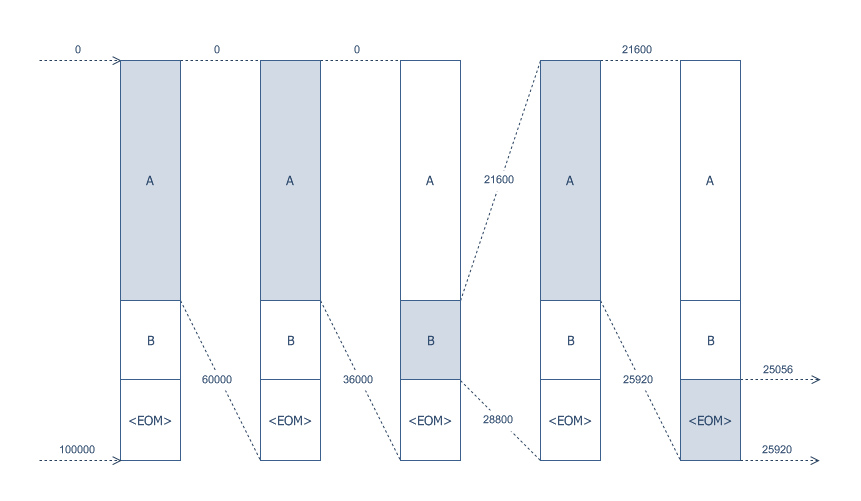
Range coding (or range encoding) is an entropy coding method defined by G. Nigel N. Martin in a 1979 paper, which effectively rediscovered the FIFO arithmetic code first introduced by Richard Clark Pasco in 1976. Given a stream of symbols and their probabilities, a range coder produces a space-efficient stream of bits to represent these symbols and, given the stream and the probabilities, a range decoder reverses the process.
Nº Q818947 ★
Comum · História
Range coding
Entropy coding method defined by G. Nigel N. Martin in a 1979 paper, which effectively rediscovered the FIFO arithmetic code first introduced by Richard Clark Pasco in 1976
Range coding (or range encoding) is an entropy coding method defined by G. Nigel N. Martin in a 1979 paper, which effectively rediscovered the FIFO arithmetic code first introduced by Richard Clark Pasco in 1976. Given a stream of symbols and their probabilities, a range coder produces a space-efficient stream of bits to represent these symbols and, given the stream and the probabilities, a range decoder reverses the process.
Na Wikipédia
Texto em inglês Ainda não há artigo no seu idioma: trecho em inglês.
Range coding (or range encoding) is an entropy coding method defined by G. Nigel N. Martin in a 1979 paper, which effectively rediscovered the FIFO arithmetic code first introduced by Richard Clark Pasco in 1976. Given a stream of symbols and their probabilities, a range coder produces a space-efficient stream of bits to represent these symbols and, given the stream and the probabilities, a range decoder reverses the process. Range coding is very similar to arithmetic coding, except that coding is done with digits in any base, instead of with bits, and so it is faster when using larger bases (e.g. a byte) at small cost in compression efficiency. After the expiration of the first (1978) arithmetic coding patent, range coding appeared to clearly be free of patent encumbrances. This particularly drove interest in the technique in the open source community. Since that time, patents on various well-known arithmetic coding techniques have also expired.
Texto: Wikipédia em inglês, CC BY-SA 4.0. · Imagem: jasco (talk) (CC BY-SA 3.0) ·
Cartas próximas
-

Method of complements
Method of subtraction
Nº Q4741052 ★
Sem ofertas
-

Intra-frame coding
Video frame that a compression algorithm codes independently of its neighbors
Nº Q1262687 ★
Sem ofertas
-

Numeração de borda
Nº Q2552324 ★
Sem ofertas
-

A Million Random Digits with 100,000 Normal Deviates
Book of random number tables
Nº Q4658263 ★★
Sem ofertas
-
C
C0 and C1 control codes
Control characters in Unicode, ranging from U+0000 to U+001F and U+007F (C0), and from U+0080 to U+009F (C1)
Nº Q718147 ★★
Sem ofertas
-
B
Byte-pair encoding
Algorithm for data compression and tokenization that iteratively replaces the most frequent pairs of consecutive bytes or symbols with a new representation
Nº Q860962 ★★
Sem ofertas
-

GIF
Família de formato de arquivo de imagem bitmap
Nº Q2192 ★★★
Sem ofertas
-
F
First normal form
Minimum requirement in database normalization
Nº Q1366465 ★★
Sem ofertas
-

Algoritmo RANDU
Nº Q1067478 ★
Sem ofertas
-

Lavarand
Random number generator based on lava lamp motion
Nº Q6502402 ★★★
Sem ofertas
-
S
Speedcoding
Linguagem de programação
Nº Q7475416 ★
Sem ofertas
-
A
Algoritmo probabilístico
Nº Q583461 ★
Sem ofertas
-

A-law algorithm
Algorithm
Nº Q278059 ★
Sem ofertas
-
F
Fórmula BBP
Nº Q803807 ★
Sem ofertas
-

Código SINPO
Código de brevidade para relatórios de sinais de rádio
Nº Q1191306 ★
Sem ofertas
-

Codificação de Huffman
Nº Q2647 ★★★
Sem ofertas
-

Xadrez de Fischer
Nº Q724903 ★★★
Sem ofertas
-
E
Entropy in thermodynamics and information theory
Relationship between the concepts of thermodynamic entropy and information entropy
Nº Q5380803 ★
Sem ofertas